

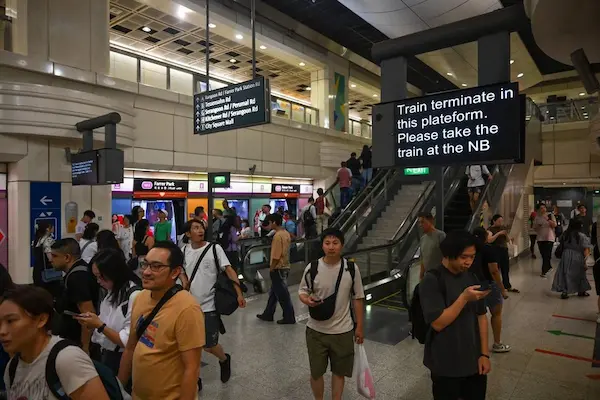
Singapore’s North East Line resumed normal operations on Tuesday afternoon (August 12, 2025) after a three-hour disruption caused by a major power fault, but commuters in Sengkang and Punggol continue to face transport woes as the Sengkang-Punggol LRT still down hours after the initial incident.
The transport disruption began at approximately 11:00 AM when a power fault brought services on the North East Line to a complete halt between Farrer Park and Punggol Coast stations, affecting 11 stations along the line. The incident also knocked out power at several stations, plunging Punggol and other affected stations into darkness with no lights, air conditioning, or escalators functioning.
Timeline of Events and Service Restoration
The power fault was first reported by SBS Transit at 11:17 AM on Tuesday morning, with the transport operator initially estimating that service restoration would take two to three hours. True to their prediction, North East Line services gradually resumed by 2:10 PM, with SBS Transit confirming full restoration by 2:19 PM.
However, whilst the main NEL service returned to normal operations, the Sengkang-Punggol LRT still down situation has persisted throughout the day. The Sengkang LRT service was restored at 3:34 PM, but Punggol LRT services remained suspended as of late Tuesday afternoon, with operators working progressively to restore the light rail system.
Cause and Impact of the Disruption
SBS Transit’s CEO Jeffrey Sim issued a public apology for the inconvenience caused to affected commuters, emphasising that the company takes the matter “very seriously” and is investigating the root cause of the incident. Initial investigations have not yet revealed the specific technical cause of the power fault, though the disruption was significant enough to affect multiple transport systems simultaneously.
The power fault had a cascading effect beyond just the train services. Commuters reported complete blackouts at several stations, with Punggol station experiencing what witnesses described as a “complete blackout.” Emergency lighting systems remained operational, but air conditioning, escalators, and main lighting systems were completely disabled.
The severity of the power fault was evident from commuter reports of hearing “cracking noises” on trains just before the disruption, accompanied by smoky odours. Some passengers were evacuated from trains onto the tracks as a safety precaution, highlighting the serious nature of the electrical fault.
Alternative Transport Arrangements
During the disruption, SBS Transit implemented comprehensive alternative transport arrangements to maintain connectivity for affected commuters. Free regular and bridging bus services were deployed at designated bus stops along the affected stations, with services available at major interchanges including Sengkang Bus Interchange, Buangkok Bus Interchange, Hougang Bus Interchange, Serangoon Bus Interchange, and Woodleigh Bus Interchange.
The transport operator maintained partial NEL services between Harbourfront and Farrer Park stations throughout the disruption, allowing commuters to access alternative routes via the Circle Line at Serangoon station or other connecting lines.
Continuing LRT Challenges
The fact that the Sengkang-Punggol LRT still down hours after the NEL restoration highlights the interconnected nature of Singapore’s rail network and the vulnerability of shared power systems. The Sengkang-Punggol Light Rail Transit system, which serves as a crucial feeder service for residents in these densely populated new towns, appears to have been more severely affected by the power fault.
Punggol residents faced particular challenges as their primary transport link remained suspended well into the evening hours. The LRT system serves thousands of residents daily, connecting them to the main North East Line for onward journeys to other parts of Singapore.
Broader Context of MRT Reliability
This incident represents another significant disruption to Singapore’s MRT network, occurring just weeks after Transport Minister Chee Hong Tat expressed disappointment over recent train service disruptions. The August 12 power fault adds to growing concerns about the reliability of Singapore’s public transport system, particularly during peak travel periods.
The disruption comes at a time when Singapore’s rail network faces increasing scrutiny over service reliability. The interconnected nature of the power supply system, as demonstrated by how a fault on the NEL affected the separate LRT system, raises questions about redundancy and backup systems in critical transport infrastructure.
Recovery and Investigation Efforts
SBS Transit has committed to conducting a thorough investigation into the root cause of the power fault, working closely with the Land Transport Authority. The operator’s initial response time and alternative transport arrangements were generally well-received by commuters, though the extended duration of the LRT disruption has caused ongoing inconvenience.
The progressive restoration of services, with the main NEL line recovering first followed by partial LRT restoration, suggests a systematic approach to bringing systems back online safely. However, the fact that the Sengkang-Punggol LRT still down situation persisted indicates the complexity of the power fault and the time required to fully restore all affected systems.
Impact on Daily Commuters
The disruption had significant implications for thousands of daily commuters, particularly those travelling during the lunch period and afternoon hours. Many commuters reported missing appointments, classes, and work commitments due to the unexpected service suspension.
The blackout conditions at stations created additional safety concerns, with commuters having to navigate darkened stations and use emergency staircases. The smell of smoke reported by some passengers added to the anxiety, though SBS Transit staff managed the evacuation procedures effectively.
For residents of Sengkang and Punggol, the extended LRT disruption meant relying heavily on bus services and private transport options, leading to increased congestion on alternative routes. The Sengkang-Punggol LRT still down situation particularly affected residents in the outer reaches of these new towns, who depend on the light rail system for first and last-mile connectivity.
Looking Forward
As investigations continue into the cause of this major power fault, transport authorities will need to examine the resilience of shared power systems across Singapore’s integrated rail network. The incident demonstrates how a single point of failure can cascade across multiple transport modes, affecting both heavy rail and light rail systems.
The Sengkang-Punggol LRT still down situation serves as a reminder of the critical importance of redundant power systems and rapid response capabilities in maintaining transport reliability. As Singapore continues to expand its rail network and increase ridership, ensuring system resilience becomes increasingly vital for maintaining public confidence in public transport.
Transport operators are expected to share detailed findings from their investigation once completed, along with any measures to prevent similar incidents in the future. The focus will likely be on improving power system redundancy and reducing the risk of cascading failures across interconnected transport networks.






The MIHAS Awards 2026, Honouring Halal Excellence, Innovation and Sustainability!

Arrow Electronics Signs MoUs to Help Advance Technology Innovation in Thailand’s Electronics Industry

MSIG Hong Kong’s 2025 Claims Report Reveals Growth in Claims Settlement Ratio for Fifth Consecutive Year and Spotlights Award-Winning Travel Insurance Offerings

Decathlon Sports Fest 2026: Free Sports Weekend

Educational Things to Do in Singapore with Kids & Teenagers

Butterbear Happy Walk 2026: Singapore’s Cutest 3KM Event

Free Things To Do in Singapore for Budget Travellers

The MIHAS Awards 2026, Honouring Halal Excellence, Innovation and Sustainability!

Arrow Electronics Signs MoUs to Help Advance Technology Innovation in Thailand’s Electronics Industry

MSIG Hong Kong’s 2025 Claims Report Reveals Growth in Claims Settlement Ratio for Fifth Consecutive Year and Spotlights Award-Winning Travel Insurance Offerings
