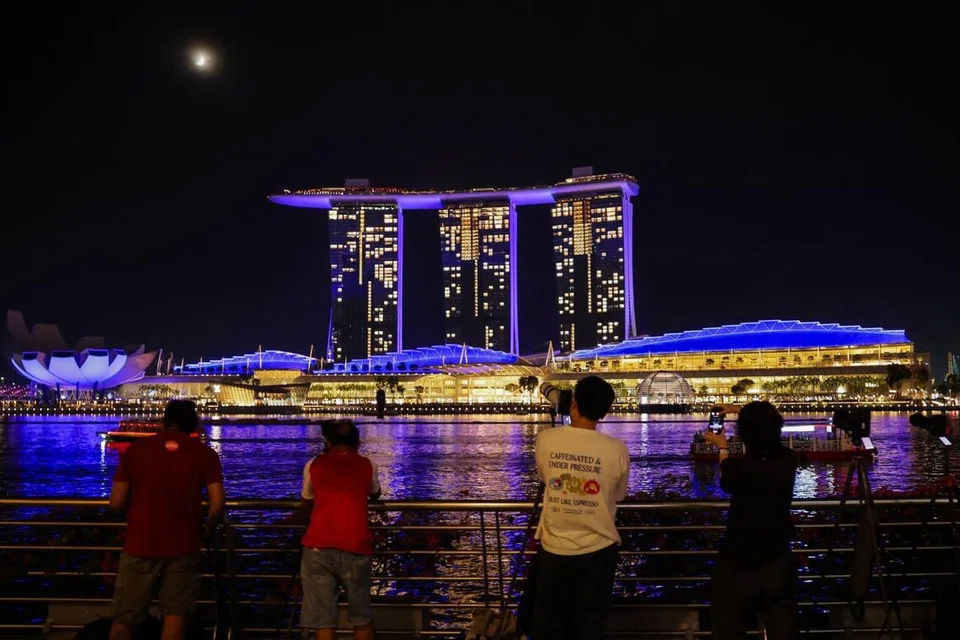
Photo Credit: Straits Times
The blood moon 2026 captivated skywatchers across Singapore on the evening of March 3, painting the night sky with an eerie red glow. This rare total lunar eclipse, coinciding with Chap Goh Mei—the final day of Chinese New Year—drew crowds to open spaces, parks, and rooftops despite variable weather. For those who missed it due to clouds, work, or simply not knowing, fret not: another opportunity awaits, though patience will be required.
What Made the Blood Moon 2026 So Special?
A blood moon occurs during a total lunar eclipse, when Earth positions itself directly between the Sun and the Moon. Sunlight bends through our planet’s atmosphere, scattering shorter blue wavelengths while allowing longer red ones to reach the lunar surface. The result? The Moon transforms into a striking coppery or rusty orb, often likened to a celestial drama unfolding overhead.
On March 3, 2026, the event began as the Moon rose in the east around 7:15pm local time. Partial umbral eclipse started shortly after, with totality—the peak blood moon phase—kicking in by 7:47pm and lasting until 8:02pm. The Moon slipped out of Earth’s darkest shadow by 9:17pm, gradually regaining its silvery brightness. Visibility spanned islandwide, from Changi to Jurong, provided clouds parted.
This eclipse held extra significance in Singapore. Falling on the 15th day of the Lunar New Year, it blended astronomical wonder with cultural festivity. Families gathered for lantern processions and orange-tossing traditions, only to glance skyward at the reddening Moon. Science Centre Singapore hosted free viewing events with telescopes, drawing hundreds despite one-minute-per-person limits for crowd control. Even planets like Mars and Saturn joined the show, twinkling nearby for bonus stargazing.
Eyewitness accounts flooded social media: “The Moon looked like a giant ruby rising over the HDB blocks,” one observer shared. Another noted, “Clouds teased us at first, but cleared just in time for totality—pure magic.” For photographers, the low horizon position created dramatic silhouettes against the city skyline, with Regulus—the “Lion’s Heart” star in Leo—shining brightly beside the eclipsed Moon.
Why Did Some Miss the Blood Moon 2026?
Urban living in Singapore poses challenges for celestial events. High-rise buildings obstructed eastern views for many, while light pollution from the bustling city dims fainter stars. March’s tropical weather delivered patchy clouds, frustrating some in the west and north. Those asleep early or unaware—perhaps scrolling TikTok instead of checking astronomy apps—woke to regretful posts.
Events like the Science Centre’s gathering highlighted accessibility issues. Free entry sounded ideal, but registration filled fast, and wet weather contingencies meant indoor livestreams for some. Personal telescopes were banned for safety, limiting hands-on astronomy. Still, apps like Star Walk or Stellarium proved invaluable, pinpointing the Moon’s position amid skyscrapers.
No eclipse glasses needed—unlike solar events, lunar ones are naked-eye safe for all ages. Yet, optimal spots like East Coast Park, Punggol Waterway, or rooftops offered the clearest vistas. Late risers caught the Moon low and large, enhanced by the “Moon illusion” against the horizon.
Science Behind the Spectacle
Lunar eclipses demand precise alignment: Sun, Earth, Moon in syzygy. Earth’s umbra—the inner shadow—fully engulfs the Moon during totality, which lasted 15 minutes here. Atmospheric dust and pollution intensified the red hue; a smokier sky yields deeper crimson.
This blood moon 2026 was the sole total lunar eclipse of the year, visible across East Asia, Australia, Pacific, and parts of North America. In Singapore, timings aligned perfectly post-sunset, unlike Europe’s missed view. NASA likens it to “global sunrises and sunsets projected onto the Moon,” a poetic filter of refracted light.
Fun fact: The Moon’s position in Leo added flair, with Regulus outshining the dimmed lunar disc. No danger to tides or myths—pure optics, debunking old wives’ tales of doom.
When Is the Next Blood Moon in Singapore?
Disappointing news for eager astronomers: no total lunar eclipse graces Singapore skies soon. Intervening events pale in comparison. A penumbral eclipse on February 20, 2027, subtly dims the Moon without drama. July 6-7, 2028, brings a partial eclipse, nipping only part of the disc.
The next true blood moon arrives December 31, 2028—New Year’s Eve. Totality peaks around midnight UTC, visible islandwide from evening. Mark calendars; it’s over two years away, testing patience amid partial non-events.
Post-2028, December 20, 2029, offers another total stunner. Timeanddate.com lists these as fully observable from our longitude, weather permitting.
Tips to Catch Future Blood Moons
Preparation elevates the experience. First, track via reliable sites like Timeanddate.com or Science Centre alerts. Choose horizons: eastern parks like Bedok Reservoir or Sentosa beaches minimise obstructions.
Pack binoculars for detail—spot craters on the red surface. Apps simulate views, factoring haze. Join communities: Singapore Astronomical Society or Facebook stargazing groups share spots and forecasts.
Weather apps are allies; March’s inter-monsoon showers demand flexibility. Indoors? Stream via NASA or Virtual Telescope Project. Families, turn it educational: explain shadows with torches beforehand.
Photographing? Use tripods, long exposures for colour pops. No filters—just steady hands.
Why Blood Moons Captiv ate Singaporeans
In our concrete jungle, such events reconnect us to the cosmos. The blood moon 2026 sparked wonder amid daily grind, blending science and heritage. Schools incorporated it into lessons; influencers captured timelapses going viral.
Culturally, eclipses evoke folklore—dragons devouring the Moon—but science prevails. Rising interest in astronomy, post-COVID outdoor booms, positions Singapore as a prime spot. With clear equatorial skies occasionally, future events promise more.
Looking Ahead: Eclipse Enthusiast’s Guide
Beyond lunars, 2026-2028 features solar clips, though annular paths skirt us. Drone footage or hilltop vigils enhance views. Invest in a starter scope; clubs offer loans.
Missed this blood moon 2026? Channel FOMO into readiness. By 2028, you’ll regale tales of March 3’s glow. The universe schedules no reruns—stay vigilant.
In summary, while the wait tests resolve, Singapore’s next blood moon beckons. Dust off binoculars; the night sky rewards the watchful.






Mengniu’s Chinese Culture Pavilion Captivates the World at the FIFA World Cup

House of Origin Elevates the Cantonese Culinary Canon with Pristine Expressions for Summer

Breaking the Bed Bug Control Industry Bottleneck: Nobedbugs-HK Redefines Global Bed Bug Eradication Standards with Proprietary Technology

Educational Things to Do in Singapore with Kids & Teenagers

Butterbear Happy Walk 2026: Singapore’s Cutest 3KM Event

SG61 Deals: Top National Day Steals

Kopi Siew Dai at Starbucks: Local Brew Twist
Mengniu’s Chinese Culture Pavilion Captivates the World at the FIFA World Cup

House of Origin Elevates the Cantonese Culinary Canon with Pristine Expressions for Summer

Breaking the Bed Bug Control Industry Bottleneck: Nobedbugs-HK Redefines Global Bed Bug Eradication Standards with Proprietary Technology