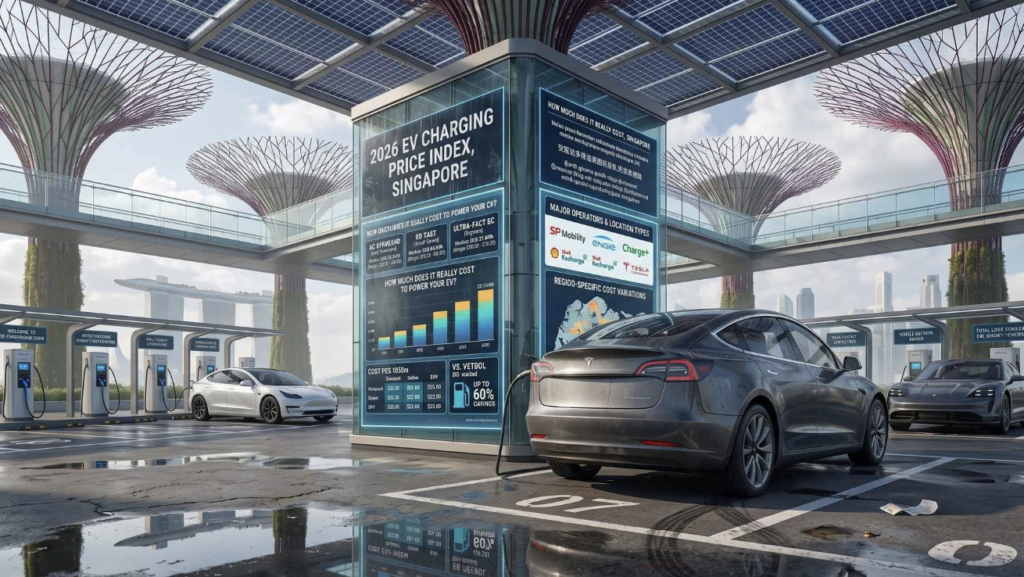

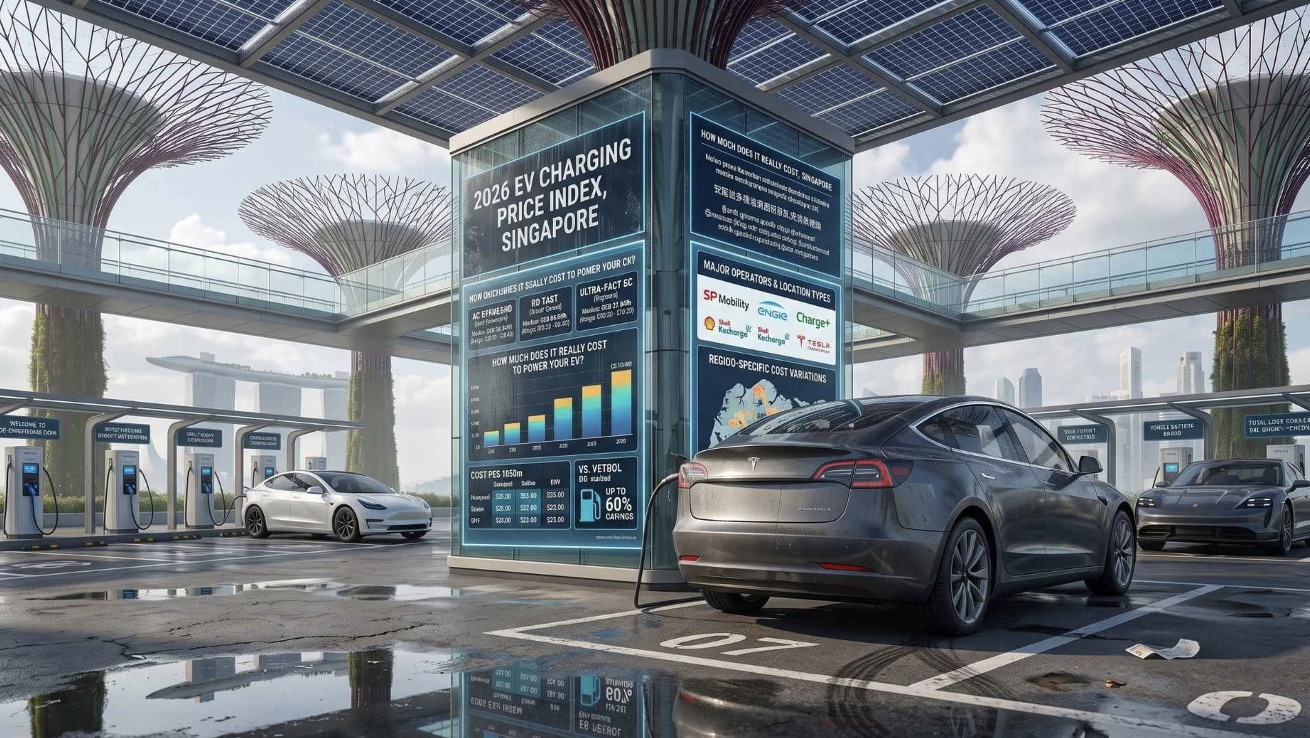





Photo Credits: Motorist
Singapore had deployed more than 30,500 electric vehicle charging points as of March 2026, surpassing the halfway mark toward its national target of 60,000 chargers by 2030, according to the Land Transport Authority (LTA). Electric vehicles accounted for 57.6% of new car registrations in the first quarter of 2026, up sharply from 45% across all of 2025. The government has also committed to giving every HDB town at least one fast-charging hub by the end of 2027.
This guide breaks down what the current rollout actually means if you are considering an EV or already own one.
As of March 2026, Singapore had more than 30,500 EV charging points deployed, according to LTA, putting the country past the halfway mark toward its 2030 target of 60,000 chargers. The plan splits the target between 40,000 chargers in public car parks and 20,000 in private premises. LTA is coordinating with the Energy Market Authority, HDB and JTC Corporation to support this deployment alongside necessary electrical infrastructure upgrades.
For context on how quickly this has grown, charging stations numbered almost 6,000 by December 2023, meaning the network has expanded roughly fivefold in a little over two years.
Adoption has accelerated notably. EVs made up 57.6% of new car registrations in the first quarter of 2026, a sharp jump from 45% across the whole of 2025, according to LTA’s own figures. As of November 2025, there were 46,029 electric vehicles registered in Singapore, equivalent to roughly 7% of all vehicles on the road at that point, according to Wikipedia’s tracking of Singapore’s EV statistics sourced from LTA data.
Here is a quick summary of the current state of the rollout.
Metric | Figure | As Of |
Total EV chargers deployed | 30,500+ | March 2026 |
2030 target | 60,000 chargers | N/A |
EVs as share of new registrations | 57.6% | Q1 2026 |
Registered EVs (total) | 46,029 (~7% of all vehicles) | November 2025 |
HDB fast-charging hub commitment | Every town, minimum 1 hub | By end of 2027 |
Financial incentives remain part of the push as well. The EV Early Adoption Incentive and Enhanced Vehicular Emissions Scheme can reduce the upfront cost of an electric car by up to $40,000, according to the Ministry of Transport, alongside a downward revision of road tax for electric cars that took effect from 1 January 2021.
If broader Singapore tech shifts interest you beyond EVs specifically, our State of Tech in Singapore report covers other consumer-facing changes happening this year.
Here is the honest answer. The charging network has genuinely improved to the point where range anxiety, once the biggest deterrent, is less of a practical concern than it was even two years ago, particularly for HDB residents given the government’s commitment to fast-charging hubs in every town by 2027. That said, not every HDB carpark yet has a charger, and depending on which town you live in, convenient home charging may still require some planning around your specific block’s rollout timeline.
One limitation worth stating plainly. While more than 60% of HDB carparks had charging points deployed as of March 2025, according to the Ministry of Transport, that still leaves a meaningful share of carparks without chargers at all. Checking your specific HDB block’s charger status before committing to an EV purchase is a practical step worth taking rather than assuming based on the national average.
For more updates on Singapore Tech and green transport push as new figures are released, browse our Tech section for ongoing coverage.
How do I find the nearest EV charger in Singapore? The LTA-supported MyTransport App and individual EV charging operator apps both allow drivers to locate chargers, check availability and make payment, typically via QR code or the operator’s own payment terminal.
Do all EVs in Singapore use the same charging plug type? EVs in Singapore are generally fitted with two types of charging inlets, Type 2 and Combo 2, which are found at all public chargers, so compatibility is less of a concern than it might be in markets with more fragmented charging standards.
Is it cheaper to charge an EV at home or at a public charger? Charging speed and cost both depend on the charger type. AC chargers, predominantly under 23kW, are generally the main mode for home charging and tend to be lower cost, while DC chargers, rated above 23kW, are designed for faster, more opportunistic or urgent charging at a higher cost.
What incentives are available for buying an electric car in Singapore? The EV Early Adoption Incentive and Enhanced Vehicular Emissions Scheme together can reduce the upfront cost of an electric car by up to $40,000, according to the Ministry of Transport, alongside separate incentives for commercial and heavy vehicles switching to zero-emissions models.
Will every HDB block have EV chargers eventually? The government has committed to every HDB town having at least one fast-charging hub by the end of 2027, alongside the broader national target of 60,000 chargers by 2030, though the exact rollout pace can vary by specific town and block.
If you have a question about EV charging in your specific neighbourhood, email us at admin@dei.com.sg.